I was doing some work tonight and got distracted by watching some "Hell's Kitchen". If you don't know it, it's a reality tv show where aspiring chefs compete with one another to win a restaurant. What's great about the show is the judge, Chef Ramsey. If you thought Simon Cowell was a tough guy, go home. Ramsey is a drill sargeant wrapped in a tyrant's apron. It's one of my favourite shows.
Ramsey had another show on Foodtv called 'Ramsey's Kitchen Nightmares'. In this show he tries to revive struggling restaurants using his familiar tactics. Some find it way over the top. Others understand that this is the nature of the cooking business. Either way it's stressful to watch and wildly entertaining. I'll make it clear here that I would never want to work for someone like him. That goes without saying.
What I like about Ramsey is that his work philosophy speaks to a great life philosphy. He encourages effort and is brutally honest about talent. He pushes everyone to do their best and rewards them when they acheive it. He asks the tough question everyone should ask themselves: If you're not passionate about your work, what the hell are you doing with your life? Passion, desire, focus and commitment.
Add a dash of self reliance and you might find yourself.
Tuesday


Ralph
"There is a time in every man's education when he arrives at the conviction that envy is ignorance; that imitation is suicide; that he must take himself for better, for worse, as his portion; that though the wide universe is full of good, no kernel of nourishing corn can come to him but through his toil bestowed on that plot of ground which is given to him to till."
Whenever I'm looking for some inspiration I gravitate back to Ralph Waldo Emerson and his essay 'Self Reliance'. I was reminded of this essay last night while having a few pints with a friend. We were talking about music and art and how sometimes something echoes so clearly in our minds like it's innate knowledge. The story told is of the composition of the song Yesterday and how after writing it, Paul McCartney needed confirmation that he hadn't written something he'd heard before. There was such truth in it's simplicity that he felt it couldn't have been original. The story made me think of Emerson and his belief that there are universal truths and if you can trust yourself then you can find your way to them. "A man should learn to detect and watch that gleam of light which flashes across his mind from within, more than the lustre of the firmament of bards and sages. Yet he dismisses without notice his thought, because it is his. In every work of genius we recognize our own rejected thoughts: they come back to us with a certain alienated majesty."
Is this a simplistic ideal or does it ring of truth? Outside of culture, race, religion and politics, do we share these inner truths? And what constitutes 'truth'? Maybe it's just something sewn into our genes and it echoes through generations.
What I like about Emerson is that he inspires courage in the face of self doubt. Our fear is so often tied to failure that we fall short of our potential and are far too timid in our careers and relationships. And I suppose it's a little ironic that I say that Emerson inpsires me as the point he's making is that I should be inspiring myself! Oh well.
Whenever I'm looking for some inspiration I gravitate back to Ralph Waldo Emerson and his essay 'Self Reliance'. I was reminded of this essay last night while having a few pints with a friend. We were talking about music and art and how sometimes something echoes so clearly in our minds like it's innate knowledge. The story told is of the composition of the song Yesterday and how after writing it, Paul McCartney needed confirmation that he hadn't written something he'd heard before. There was such truth in it's simplicity that he felt it couldn't have been original. The story made me think of Emerson and his belief that there are universal truths and if you can trust yourself then you can find your way to them. "A man should learn to detect and watch that gleam of light which flashes across his mind from within, more than the lustre of the firmament of bards and sages. Yet he dismisses without notice his thought, because it is his. In every work of genius we recognize our own rejected thoughts: they come back to us with a certain alienated majesty."
Is this a simplistic ideal or does it ring of truth? Outside of culture, race, religion and politics, do we share these inner truths? And what constitutes 'truth'? Maybe it's just something sewn into our genes and it echoes through generations.
What I like about Emerson is that he inspires courage in the face of self doubt. Our fear is so often tied to failure that we fall short of our potential and are far too timid in our careers and relationships. And I suppose it's a little ironic that I say that Emerson inpsires me as the point he's making is that I should be inspiring myself! Oh well.
Monday
Homeowner
Sylvia and I bought a house yesterday! We were toying with the idea and then dived in head first. Needless to say, it was a very exciting weekend.
Debt is a funny thing. One minute you are worried about ridding yourself of it then the next minute you are signing a significant part of your life away to it. It is all a part of the game of life I suppose. Nothing is permanent. We work so that we can be comfortable. Some people will scoff at this apparent truce that we play with life, comfort. Comfort isn't a bad thing but stagnation is. To stagnate or become 'set in your ways' is what is what we should fear.
Debt is a funny thing. One minute you are worried about ridding yourself of it then the next minute you are signing a significant part of your life away to it. It is all a part of the game of life I suppose. Nothing is permanent. We work so that we can be comfortable. Some people will scoff at this apparent truce that we play with life, comfort. Comfort isn't a bad thing but stagnation is. To stagnate or become 'set in your ways' is what is what we should fear.
Friday
Famous Last Words

Around 6 years ago I edited a television show called 'The Writing Life'. It was a fairly easy show as we shot footage of 13 authors speaking to a group of novices and packaged it. Each writer would read from some of their own works and share some insights into the life of the writer. One such episode featured the late great Timothy Findley who came with a prepared piece that he proceeded to read. He was the toughest author to edit as he basically read this essay that went over our allotted time of 26 minutes. I had to find something to remove in a piece that was tightly prepared without damaging the integrity of the content and meaning. Needless to say, I proceeded with the care of a surgeon and dissected some time out to make it conform.
This terrific speech involved his novel 'Famous Last Words' and his own internal struggle with the famous poet Ezra Pound. Findley's main character in the book is named Mauberley and references Pound's poem 'Hugh Selwyn Mauberley'. Pound's poem is said to be somewhat autobiographical. For Findley, Ezra Pound was capable of creating such brilliance in his work but was in stark contrast to Pound's own personality and politics. Pound was a supporter and propagandist for Benito Mussolini and the fascist movement as well as an anti-Semite. How could so much hate produce such wonderful work? How can you reconcile your admiration and enjoyment of this man's talents with your dislike for the man and what he stood for?
After World War II Pound gave himself up to the American Forces and was sent back to America to stand trial for treason. Pound was never convicted as he was considered unfit for trial due to insanity.
Timothy Findley read a passage from Famous Last Words that has stuck with me since. It was such a beautiful passage from the book and I was compelled to look it up and share it here.
"And out of the corner of my eye I caught a glimpse of something irresistible above my head, seen in the ebb and flow of the swinging light: the imprint of a human hand.
God only knew how long ago it had been put there. Maybe ten - and maybe twenty thousand years before. This is my mark, it said, My mark that I was here. All I can tell you of my self and of my time and of the world in which I lived is in this signature: this hand print; mine.
I saw these animals. I saw this grass. I saw these stars. We made these wars. And then the ice came.
Now the stars have disappeared. The grass is gone; the animals are calling to us out beyond this place - the frozen entrance to this cave.
In days or hours we will have died. We cannot breathe. The lanthorn flicks. All the air is gone. I leave you this: my hand as signature beside this images of what I knew. Look how my fingers spread to tell my name.
Some there are who never disappear. And I knew I was sitting at the heart of the human race - which is its will to say I am."
Findley spoke at my graduation ceremony when I graduated from my English Degree in 1995. He said that he felt that it was imagination that separated man from the animals. Our gift in life is our ability to 'imagine more' than ourselves. It's the age old question: would you rather be a fully contented pig or a half contented human? The answer is all yours. I'm sure Pound would have agreed with Findley... at least on that point.
Thursday
Clash by Night
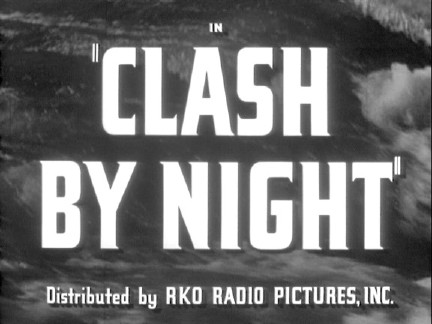
I've been a fan of Film Noir since I saw The Third Man in the early 90's and started to read and watch anything I could get my hands on. Although The Third Man isn't really considered an absulute Film Noir, it is recognized as having some of the qualities of Noir. I won't go in depth about it here but there are many intellectual disagreements over whether Film Noir is a style of film or whether it is an actual genre (or sub genre). Some argue that it was born out of post war America and the movement ended in the late 1950's with Orson Welles' Touch of Evil. Since there is no real definitive answer I won't delve into the middle of the debate as in the end it probably doesn't really matter.
Clash by Night is a Film Noir by the great German director Fritz Lang and stars Barbara Stanwyck, Paul Douglas, Robert Ryan and a young Marilyn Monroe. The story begins with Barabara Stanwyck returning home to Monterey after a failed Marriage. She's a lost soul, a gold digger looking for that elusive thing that will bring her happiness. She moves back in with her brother and ends up being courted by her brothers boss Jerry, played by Paul Douglas. Jerry is a kind man who owns a fishing boat and lives with and takes care of his uncle and father. Stanwyck reluctantly gives in to Jerry hoping that his kindness and security will satisfy her. It doesn't. They have a child together but Mae (Stanwyck) is restless and ends up having an affair with the brash and indignant Earl played by Robert Ryan. He's an exciting but stormy character and he does his best to seduce Mae.
The film doesn't have much actual violence but it is brimming with the idea of violence. The young women are head strong yet vulnerable to the type A male. They are bullied and threatened and they can't help but fall in love. Jerry, the kindest and gentlest of the men, is cuckolded and ridiculed. Film Noir always finds it's way to these primal emotions. It combines sex and violence and watches as the weak stumble and fall from grace. Jerry doesn't deserve any of what he gets but it's not up to him. Stanwyck, like in Billy Wilder's Double Indemnity, is 'rotten' (a word used in both films) - a self serving femme fatale.
In some ways Clash by Night is reminiscent of another terrific Lang film, 'Scarlett Street' starring the great Edward G Robinson. In both films the mature and kind gentlemen are played for fools by the young women. The subtext of these films seem to suggest that young women are to be feared. Women in youth are in their prime and can use their sexuality as a weapon for self gain. Feminists would call this misogyny and a male excuse to keep women's sexuality repressed. I think they have a point. Regardless of the politics both of these films are supreme examples of Lang's ability to infuse his films with raw emotions.
I think I enjoy Noir so much partly because the stories are edgy and lacking of some of the theatrical melodrama that you find in other films of the period. I also like them because they start to stab at themes and ideas that suggest that we are all a little corrupt and given the opportunity, we too could fall from grace.
Of particular historical interest, Clash by Night starts off with documentary footage of Monterey and the fisheries. Lang sets up his story location with real shots of the birds, seals, boats and docks. He combines them with footage of his actors including Marilyn Monroe working in Cannery Row canning fish (even these images couldn't diminish her appeal). We see the waves crash against the coast of Monterey - a great foreshadowing of things to come.
Tuesday
The Right Stuff
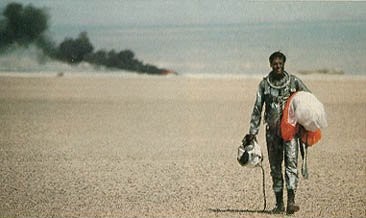
I screened 'The Right Stuff' again last night and it confirmed for me its place as an American classic. It's a superior juggling act of a story that is told over years - from the 1940's test piloting and the breaking of the sound barrier to the 1960's Mercury missions where the pilots become Astronauts and orbit the earth. At three hours plus, the film is engaging in every step with a great balance of character, history and technology. It is the focus on the characters that makes it so memorable. It's even more impressive when you consider that you're forty plus minutes into the film before most of the main characters appear.
The beginning of the film concerns itself with Chuck Yeager and the constant progression of air technology. Yeager becomes the first man to break the sound barrier and, for a brief time, is 'the fastest man on earth'. For a brief time. The focus of the film shifts when the Russians unexpectedly launch Sputnick. America needs to get into the space race and at this point the film leaves Chuck Yeager behind (he doesn't try out to become an Astronaut) and we meet the seven would be astronauts John Glenn (Ed Harris), Gordon Cooper (Dennis Quiad), Alan Shepard (Scott Glenn) as well as the four others. The film follows through each of the missions as well as Chuck Yeagers famous crash involving a F 104 Starfighter. The film says that Yeager didn't have permission to take the Starfighter but Yeager says that he did, he said that he didn't have permission to try to break the altitude record set by the Russians. Regardless, Yeager lost control of the Starfighter and it crashed to the ground.
In terms of direction, Philip Kaufman does a great job of working drama, action, comedy and realism. There are many playful moments including one where Alan Shepard is kept waiting for hours on the launch pad. He makes his need to urinate known. The scientists realize they hadn't thought of that as the flight was only supposed to be for 15 minutes and they fear that if he goes in his suit he'll short something out. Kaufman then has a little fun with the moment as he presents a liquid montage - people pouring coffee, bubbles at the water cooler, engineers drinking water etc. It finally comes to a head when Shepard is finally given permission to soil himself. Other directors may have made nothing of this event but Kaufman takes the opportunity to have some fun. It's with this kind of ease that he finds his way through the story.
It's funny how this film hasn't really be seen as the classic that it is. I don't know too many people who have seen it so I think it's appropriate that I recommend it here. Don't be scared of the three hour commitment as it is one of the best three hours you'll spend in the dark.
Watch for a couple of scenes that seem to have inspired Robert Zemekis' films Forrest Gump and Contact.
Anderson Cooper
I watched some of Anderson Cooper last night on CNN. He was doing a special on America's 10 most wanted and during the program they added an old film filter on their B-roll footage - adding flicker and scratches etc. Despite the fact that it's a bit of a cheesey filter, it puts the authenticity of the piece into question. I'm not saying that the news was incorrect, it simply puts into question CNN's seriousness as a news agency. I know this isn't new (or news for that matter) and that it's a seemingly nitpicky issue, I just think that it speaks to an overall problem. We have blurred the line between entertainment and news. Style IS content, it's not something you slap on because it 'looks cool'. What is the b-roll style saying about this particular story? It's not like they were recreating vintage footage from an era gone by. It added nothing to the piece.
I watched Sidney Lumet's 'Network' a few weeks ago with Sylvia and am curious how far news will go to get a share of the audience. Hopefully not an on-air assasination. The satire has become truth.
I watched Sidney Lumet's 'Network' a few weeks ago with Sylvia and am curious how far news will go to get a share of the audience. Hopefully not an on-air assasination. The satire has become truth.
Subscribe to:
Posts (Atom)